The CLV Activation Playbook: Lenses 2 and 3, Value Momentum and Customer Lifecycle
June 10, 2026
This is the third post in our series on CLV Activation – a practical guide to turning customer lifetime value predictions into marketing investment decisions that create measurable incremental value. The framework is based on the Value-Based Segmentation developed by Theta from our work building CLV models for hundreds of brands.
CLV Activation Playbook series
Part 1: Introduction to Value-Based Segmentation
Part 2: Lens 1 — Retention & Development Matrix
Part 3: Lenses 2–3 — Value Momentum and Customer Lifecycle (current)
Part 4: Lens 4 — Purchase Persona Matrix
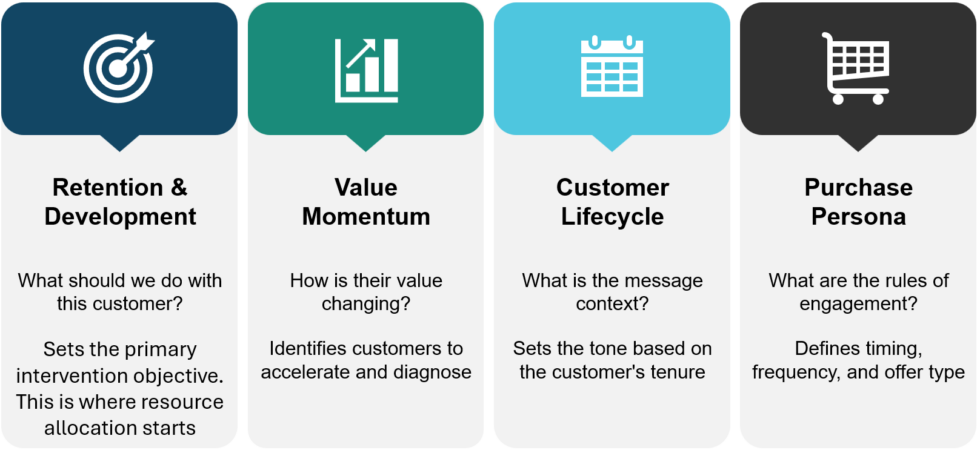
In the first post, in this series, we introduced the four lenses of value-based segmentation. In the second post, we covered Lens 1, the Retention & Development Matrix, which answers the most fundamental activation question: what should we do with this customer?
Once you have that answer, two more questions follow immediately. What approach fits this customer given the way their value is changing? And what tone fits their relationship with your brand? Lenses 2 and 3 answer those questions. They add context to the Retention & Development Matrix, turning a segment assignment into a more precise intervention hypothesis before it reaches the customer.

Lens 2: Value Momentum
Two customers can have identical Residual Lifetime Value (RLV) and sit in the same cell of the Retention & Development Matrix, yet warrant very different approaches depending on how they got there. One may be a recent convert whose value is rising fast, the other may be a long-time loyalist whose engagement has been steadily declining. The same intervention applied to both will likely produce very different outcomes.
Lens 2 captures this by looking at the value trajectory. The Value Momentum Index is the ratio of RLV to HV (Historical Value): a customer’s predicted future value relative to what they have already delivered. A high ratio is evidence that the customer may have more future value ahead than their history alone would suggest. A low ratio is evidence that expected future value may be weakening relative to the value they have already delivered.
This lens is most reliable for customers with an established purchase history and could be benchmarked within comparable tenure / lifecycle bands. For customers who have made only one or two purchases, the ratio can be volatile and should be interpreted with caution.
Two Momentum Signals to Watch

Rising Stars are repeat customers with enough observed history to make the momentum signal credible, high RLV, and a high Value Momentum Index relative to comparable customers at a similar lifecycle stage. Their predicted future value is high both in absolute terms and relative to what they have delivered so far.
The intervention hypothesis here is to accelerate that momentum instead of waiting for it to materialize on its own. These customers appear to be on a positive trajectory and may be especially responsive to the brand. The economic case for investing in that relationship now, before it plateaus, can be stronger than waiting, but should be validated against treatment cost. Post-purchase experiences that go beyond a confirmation email, early access to new collections, and cross-sell introductions that feel curated rather than generic are the kinds of interventions worth testing here. The goal is to steepen the curve.
Fallen Angels are customers with high historical value whose Value Momentum Index has dropped below the threshold, meaning their predicted future value has declined significantly relative to what they have already spent. The signal does not tell you why the relationship has weakened. It just tells you that these customers used to be very valuable but that there is much less “gas in the tank” going forward under the status quo, so the goal here is to get the curve bending back upward again.
The intervention hypothesis here is to diagnose before you offer. Sending a discount to a Fallen Angel without understanding why their engagement has declined can be an expensive mistake. It may produce a short-term transaction while leaving the root cause unaddressed, and it gives away margin in the process. A one-question survey, service-recovery prompt, or reason-code capture can add information the model cannot observe: whether the issue was product fit, price, delivery, service, life stage, or simple category exit. The framing of any communication should acknowledge their history with the brand. They were loyal once. That matters, and they should feel it.

Lens 3: Customer Lifecycle
The same customer, at different points in their relationship with your brand, needs to hear a different message. A first-time buyer who received a promotion last week is not in the same position as a customer who has been purchasing for three years. Treating them the same way – with the same tone, the same assumptions, the same campaign logic – signals that you do not actually know them.
Lens 3 segments customers by relationship maturity, defined as time since first purchase. It sets the tone and context for how you engage, ensuring that your message is appropriate to where the customer actually is in their journey with you.
To make the lifecycle thresholds meaningful rather than arbitrary, you could anchor them to a real milestone in your customer data: the median time to second purchase among customers who did go on to buy again. This is your typical activation window. Tenure defines where the customer is in the relationship; the activation window tells you when the next expected milestone should have happened. It reflects the natural rhythm of your category and your customer base, not a generic rule.
The Three Segments

New Customers are first-time buyers still within their initial activation window, defined as, for example, tenure less than twice the median time to second purchase. The single most important goal at this stage is to convert the first purchase into a second one. That conversion is where a transactional relationship begins to look like a real one, and it is one of the strongest predictors of long-term value.
The strategy here should be tiered by the customer’s RLV from Lens 1 and their Purchase Persona from Lens 4 (more on it in the next post). High and medium RLV new customers justify a more invested welcome experience: a sequence that goes beyond a confirmation email, introduces them to the breadth of the brand, and gives them a reason to return. Low RLV new customers are better served by a lighter, more automated onboarding track. The goal is the same, but the level of investment should reflect what the model expects that relationship to be worth.
Established Repeat Customers are customers with two or more purchases whose initial activation window has passed. For these customers, tenure is no longer the primary lens. Their strategy should be dictated by their position in the other segmentations: retained if they are an At-Risk VIP, developed if they are in the Loyal Core, mobilized if they are a Champion. The Lifecycle lens simply ensures the tone of those interventions acknowledges that a longer-standing relationship exists.
One-and-Dones are customers with a single purchase whose model-implied probability of being alive has fallen below a certain threshold, meaning they made one purchase, failed to activate within the expected window, and are unlikely enough to return that heavy individual-level win-back spend needs a strong economic justification. The intervention hypothesis here is different from every other segment: the value of One-and-Dones is usually not in trying to spend aggressively to win them back, but in understanding what they collectively reveal about your business. Single-purchase customers who are past the activation window but not yet below the pAlive threshold can remain in a low-cost second-purchase rescue track until the economics no longer justify it.
This segment tends to surface systemic issues: a high initial discount that attracts low-intent buyers, an introductory product that does not deliver on its promise, or an onboarding experience that fails to bridge the gap between first and second purchase. These are fixable problems and could set you on a path to fewer One-and-Dones within your next batch of acquired customers.
How Lenses 2 and 3 Work with Lens 1
Lenses 2 and 3 are not standalone segmentations. They are applied on top of the Retention & Development Matrix to add further personalization to the intervention it prescribes.
The hierarchy works as follows. Lens 1 sets the primary objective – retain, develop, win back, or suppress. Lens 2 adds strategic context by asking whether the customer’s value is rising, weakening, or stable, which shapes the approach and the message logic. Lens 3 adds tonal context by asking where the customer is in their relationship with the brand, which shapes the framing and the assumptions you can make. The output is not just a label. It is an intervention hypothesis that can be tested.
A customer who is an At-Risk VIP (Lens 1), a Fallen Angel (Lens 2), and an Established Repeat Customer (Lens 3) should receive a retention intervention that leads with diagnosis, acknowledges their history, and does not open with a discount. Each lens adds a layer. The result is a more personalized intervention than any single segmentation could produce on its own.
Example activation recipes
| Lens 1 | Lens 2 | Lens 3 | Possible treatment |
|---|---|---|---|
| Champion | Rising Star | Established Repeat | VIP recognition, early access, referral ask, no discount |
| Loyal Core | Rising Star | Established Repeat | Curated cross-sell or category expansion test |
| At-Risk VIP | Fallen Angel | Established Repeat | Diagnostic outreach, service recovery, reason-code capture before offer |
| Need Attention | Flat or uncertain | New or early tenure | Low-cost second-purchase nudge; no heavy incentive until lift is proven |
| Suppress / Monitor | Low momentum | One-and-Done | Suppress from paid win-back; analyze aggregate acquisition, product, or onboarding issues |
Coming Up Next
In Part 4, we cover Lens 4: the Purchase Persona Matrix. Once you know what to do with a customer and how to engage them, the final lens defines the rules of engagement: the timing, frequency, and offer type that fits how they actually prefer to buy.
If you are not already using predictive CLV metrics to decide which customers to retain, develop, win back, or suppress, reach out to us at ThetaCLV.com. We can show how predictive CLV turns segmentation from a reporting exercise into measurable intervention economics.