The CLV Activation Playbook: An Introduction to Value-Based Segmentation
April 6, 2026
This is the first post in our series on CLV Activation — a practical guide to turning customer lifetime value predictions into marketing actions that drive real revenue. While a fully customer-centric strategy spans the entire customer lifecycle, this series focuses on the post-acquisition side of the equation. The framework is based on the Value-Based Segmentation developed by Theta from our work building CLV models for hundreds of brands.
CLV Activation Playbook series
Part 1: Introduction to Value-Based Segmentation (current)
Part 2: Lens 1 — Retention & Development Matrix
Part 3: Lenses 2–3 — Value Momentum and Customer Lifecycle
Part 4: Lens 4 — Purchase Persona Matrix
Every brand claims to be customer centric. Very few actually are.
It’s not that marketers are insincere — it’s that most have a fundamentally flawed model of what customer centricity means. The common interpretation is something like “be nice to customers, personalize where you can, reward loyalty.” That sounds right. But it misses the core idea entirely.
As you can imagine, we have a thought or two about what customer centricity is and is not. One of our co-founders wrote the book on this stuff! What we believe is true customer centricity means recognizing that your customers are not equal — in what they need from you, in how they want to be engaged, and in what they’re worth to your business. It means treating a high-value loyal customer and a one-time discount buyer in accordance with the fundamentally different relationships they have with you. It means knowing not just who to invest in, but who to actively stop investing in.
In practice, most companies do the opposite. They send the same campaign to their entire list. They run win-back programs indiscriminately. They pour paid media budget dollars into re-engaging customers who were never going to be valuable in the first place, while their best customers receive the same generic email as everyone else. They try to make everyone happy because that will boost the satisfaction metrics.
That’s not customer centricity. That’s the illusion of it.
Value-based segmentation is what closes the gap. It’s the operational layer that turns the principle into a concrete answer to four questions, for every customer in your database.
The Four Questions a Customer-Centric Company Has to Answer
Being genuinely customer centric means being able to answer four questions every time you decide how to engage a customer:
- What should we do with this customer? Retain them, develop them, win them back, or leave them alone? This is the strategic posture, and it’s relatively stable over time.
- What is our goal? A second purchase, a higher order value, a referral, a recovery? The answer depends on both the customer and the campaign. The same high-value customer might be the target of a frequency-driving play in one campaign, such as a new product launch, and a basket-building play in another, like a tiered promotional discount during a holiday season.
- How should we communicate with them? A warm welcome, an acknowledgment of loyalty, a genuine apology, a re-engagement, or none at all? Tone should reflect both the customer’s relationship maturity, the specific context of the outreach, and the value/necessity of reaching out to them.
- What should we offer, and how much should we spend?A high-value exclusive offer, a modest discount, a bundle promotion, or nothing at all?
Most segmentation frameworks answer one or two of these questions reasonably well. We built value-based segmentation to inform all four, giving marketers the predictive inputs they need to make these decisions systematically and not just by gut.
The Predictive Foundation
Traditional segmentation looks backward: it groups customers by what they’ve already bought, how recently, and how often. These are useful signals, but they answer the wrong question. They tell you what a customer was, not what they will be.
Value-based segmentation is built on predictive metrics. At Theta, these are generated at the individual customer level by CLV Ultra, our core CLV model:
- RLV (Residual Lifetime Value) — the total revenue or profit you can expect from a customer going forward. This is your measure of future potential.
- pAlive (Probability of Being Alive) — the probability that a customer is still active and hasn’t churned. A customer who hasn’t purchased recently can still have a high pAlive if their natural buying cadence is slow.
- Predicted AOV — the expected basket size of a customer’s future transactions. This measures how much they tend to spend when they do place an order.
- Predicted Orders — the expected number of future transactions over some target time horizon. This measures a customer’s purchase frequency, telling you how often they are likely to buy.
Together, these metrics make it possible to distinguish between a customer who hasn’t bought in six months because they’re gone, and one who hasn’t bought in six months because that’s simply how they shop, and what their future behavior will look like. That distinction alone changes the decision, and the economics, completely.
The 4 Lenses: From Principle to Action
The CLV Activation Playbook translates these metrics into four overlapping lenses. Each lens adds a layer of context to the engagement decision. Start with the primary objective, layer in trajectory and relationship maturity, and arrive at a specific, personalized action.
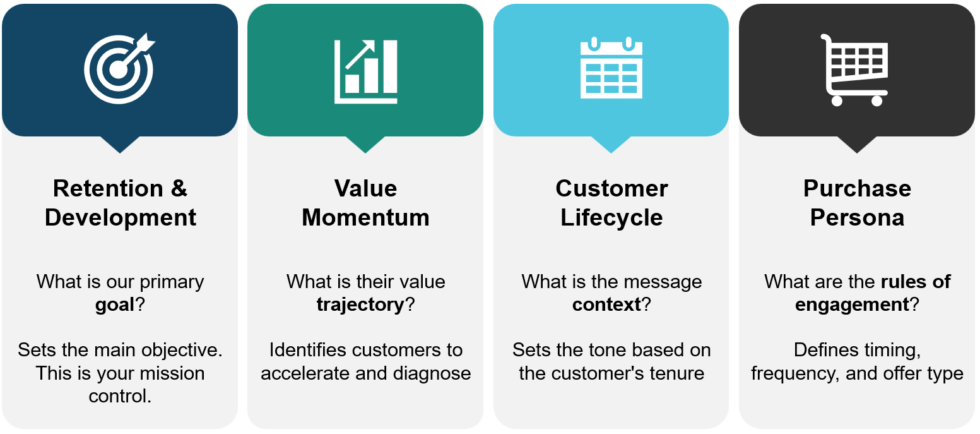
Lens 1. Retention & Development: What should we do? This is mission control. Map every customer onto a grid based on their engagement level (pAlive) and future value (RLV), and you get a clear primary objective for each one: nurture your Champions, fight to retain your At-Risk VIPs, run a calculated win-back for Hibernating Whales, and actively suppress low-potential segments before they erode your marketing ROI.
Lens 2. Value Momentum: What is our goal? A customer’s current value only tells you half the story. Are they on the way up or on the way down? Value Momentum looks at the trajectory: future potential relative to past behavior. It identifies Rising Stars on a steep upward path and Fallen Angels who were once highly valuable but are now in decline. This changes how aggressively you invest. A mid-tier customer whose value is accelerating may deserve more attention than a high-value customer who’s plateaued.
Lens 3. Customer Lifecycle: How should we communicate? Tone matters, and it should match the relationship. A first-time buyer and a three-year loyalist need fundamentally different messaging, even if they’re in the same value tier. This lens segments by relationship maturity: New Customers, Established Customers, and One-and-Dones.
Lens 4. Purchase Persona: What should we offer, and how often? Not all customers buy the same way, even at the same value level. A Big Spender who makes rare, high-value purchases should receive exclusive access and premium service, not a multi-email drip. A Browser/Snacker who buys frequently but in small amounts needs bundle promotions and shipping thresholds to lift their cart size. Same customer value, completely different playbook. This lens maps customers by predicted basket size (AOV) and predicted purchase frequency to determine both what to offer and how often to show up.
The power of this framework is in the combination. Take a customer who is an At-Risk VIP (Lens 1), a Fallen Angel (Lens 2), and a Big Spender (Lens 4). Lens 1 tells you this is a top retention priority. Lens 2 tells you the decline needs to be diagnosed before you throw an offer at them. And Lens 4 tells you that when you do reach out, it should be a single high-impact moment, not a drip campaign.
That’s what customer centricity looks like in practice: not a slogan, but a very intentional decision, made consistently, at scale, for every customer in your database.
Coming Up Next
In Part 2, we go deep on Lens 1 — the Retention & Development Matrix. It’s a 3×3 grid that maps every customer to a named segment with a clear goal and a distinct strategy, and it’s the right place to start for any brand building a value-based segmentation program for the first time.
If you’re not already using predictive CLV metrics to drive your segmentation, reach out to us at ThetaCLV.com — we’d love to show you what’s possible.