
Grow Existing Customer Value
Customer growth requires different actions for different customers. Use Value-Based Segmentation as your guide.
Let’s Talk
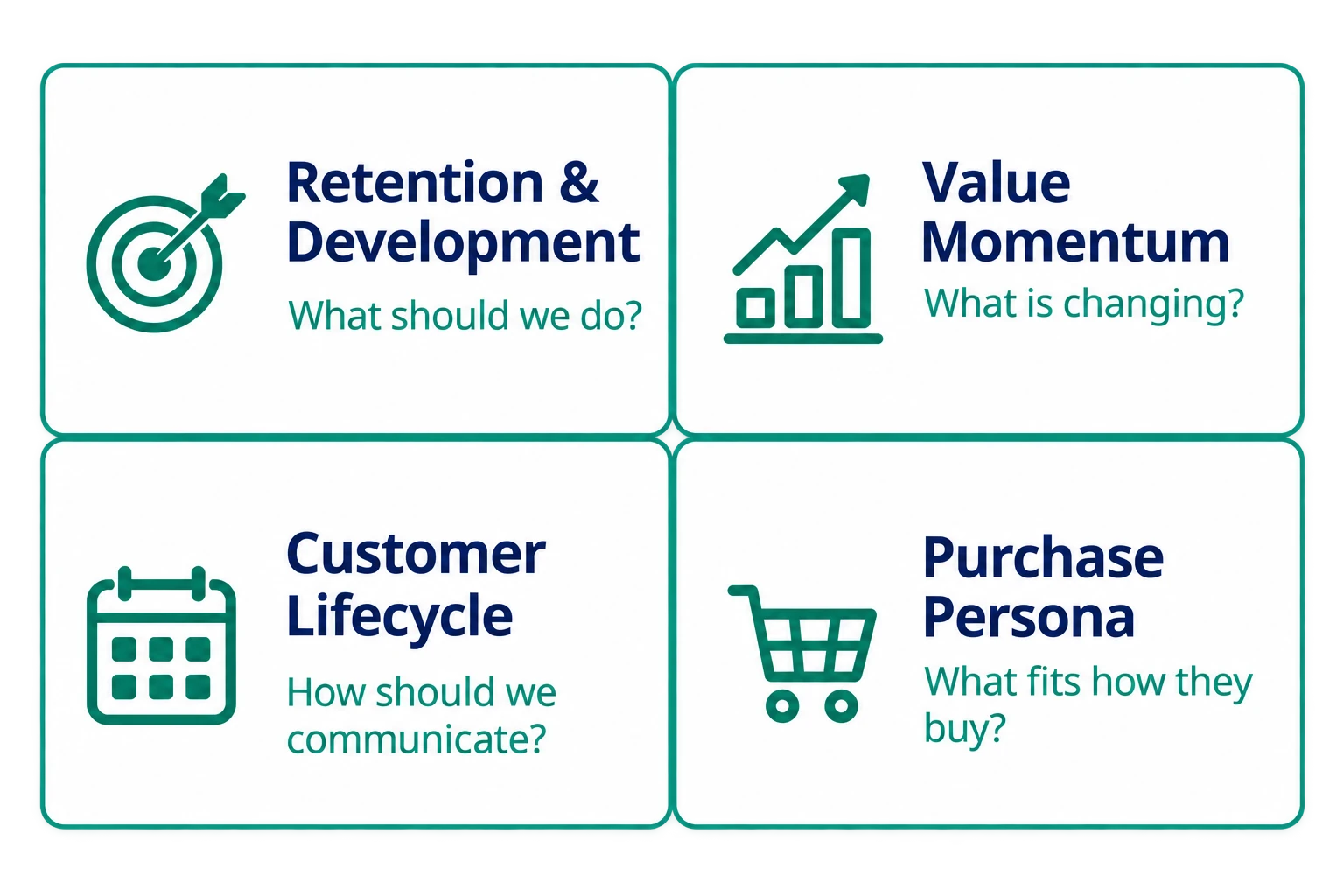
Value-Based Segmentation
Turn predictive CLV into a customer-level action plan
Traditional segments describe what a customer was, not what a company should do next. Use predictive customer value, probability of being alive, and expected purchase pattern to decide the next action for each customer.
Theta’s four lenses create a complete view of the customer opportunity. Apply them to set the primary objective, assess value trajectory, choose the right message context, and define the rules of engagement. Use each prediction to choose a customer action you can test.
Mission Control
Set the primary objective with the Retention & Development Matrix
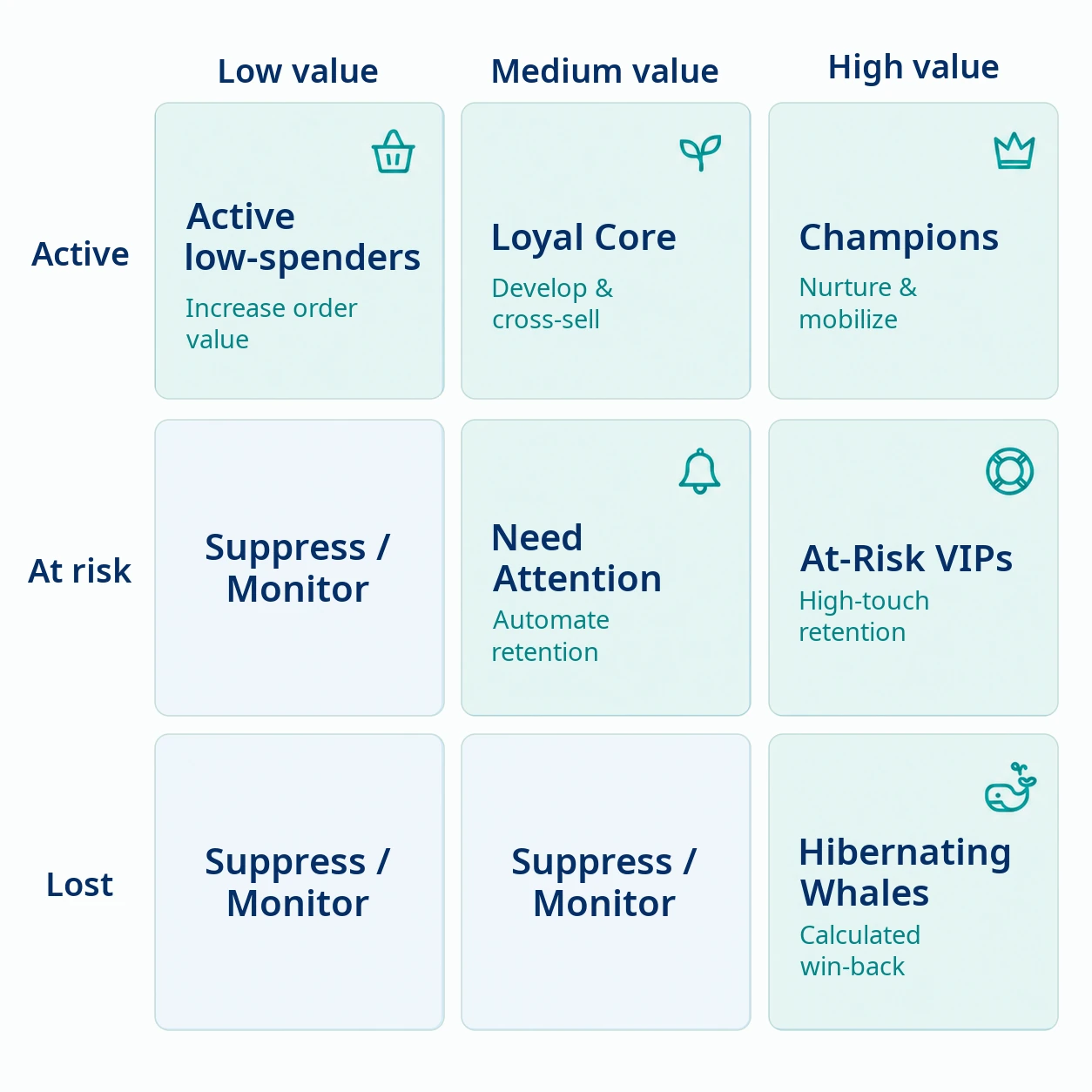
The Retention & Development Matrix connects engagement likelihood with the value a customer still has to create. Use the seven actionable segments to decide where retention, development, win-back, or suppression is economically justified.
- Nurture and mobilize Champions while developing the Loyal Core
- Prioritize high-touch retention for At-Risk VIPs and calculated win-back for Hibernating Whales
- Suppress or monitor low-RLV customers when intervention is unlikely to pay back
Context
Adjust the approach for momentum and relationship maturity
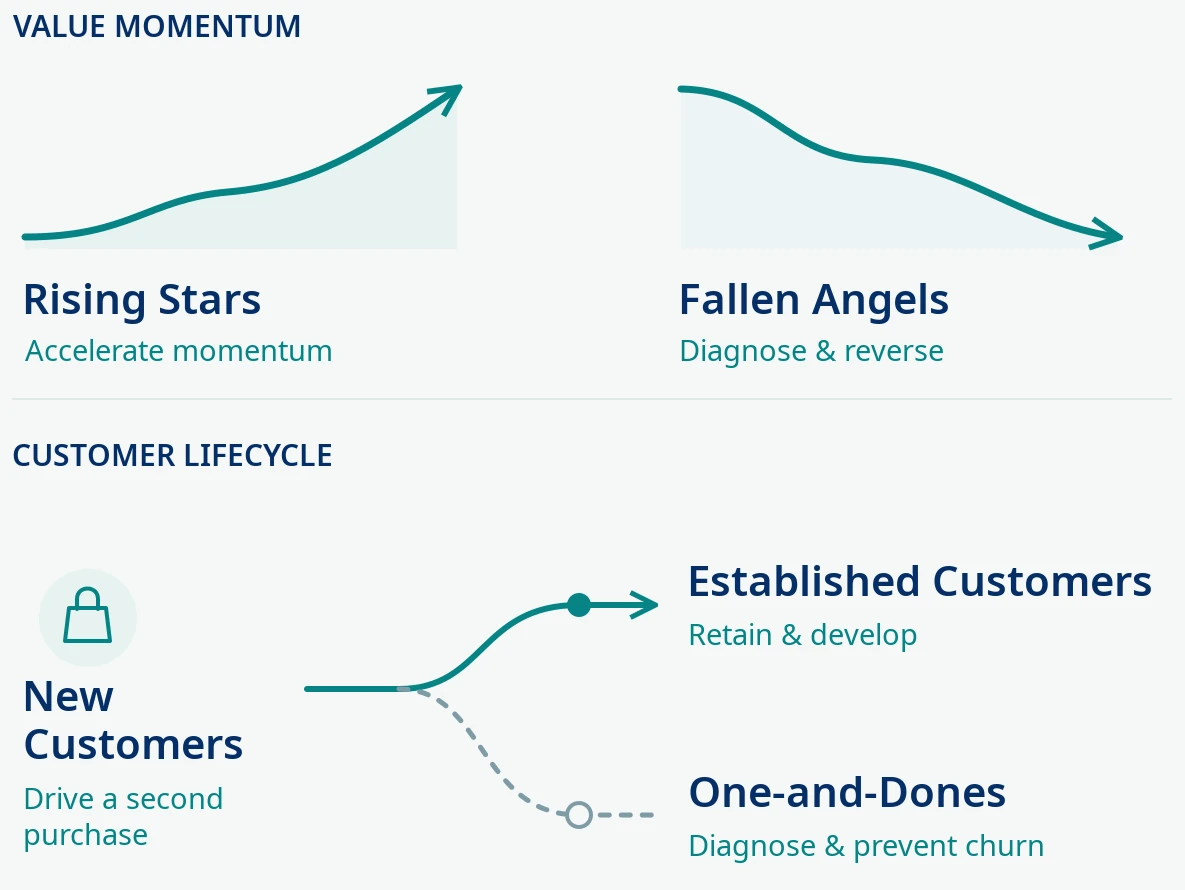
Use Value Momentum to distinguish customers whose expected value is accelerating from those in decline, then use Customer Lifecycle to match the message to the maturity of the relationship.
- Accelerate Rising Stars before their momentum plateaus
- Diagnose Fallen Angels before defaulting to a discount
- Match onboarding, retention, or diagnosis to New, Established, and One-and-Done customers
Rules of Engagement
Match offer and cadence to how customers are likely to buy
Customers with similar future value can have very different buying patterns. Map predicted basket size against predicted purchase frequency, then choose the offer, communication cadence, service level, and incentive that fit each Purchase Persona.
- Use premium access and high-touch service for infrequent Big Spenders
- Test bundles and shipping thresholds with frequent Browsers / Snackers
- Tie timing, frequency, and offer type to each customer’s predicted behavior, not averages

What You Receive
From segment assignment to testable intervention
The four lenses form a practical activation blueprint for CRM, loyalty, retention, and growth teams. Put it into market, test each intervention, and improve it with what you learn.
Customer action map
A customer-level view of who to retain, develop, win back, nurture, or suppress—and why.
Activation recipes
Specific hypotheses for objective, approach, message context, offer type, and communication cadence.
Incrementality agenda
A measurement plan to test whether each intervention creates customer value net of its cost.
Ready to Take the Next Step?
Ready to activate predictive customer value?
Talk with Theta about building a value-based segmentation program that turns customer-level predictions into measurable action.
Let’s Talk